Data center power redundancy is about more than just backup equipment. It's how utility power, UPS systems, backup generation, and transfer systems are designed to work together. Here's what the terminology means, what to ask a provider, and how DataYard's Dayton, Ohio facility is built to support private cloud and colocation clients.
What Is Data Center Power Redundancy?
When utility power is disrupted, the infrastructure supporting your critical systems becomes especially important.
Data center power redundancy is the practice of designing additional capacity and backup systems into a facility's electrical infrastructure to reduce the risk that a single component failure or utility disruption affects operations.
Backup equipment alone doesn't make a facility resilient. What matters is how each component works together as part of the overall power architecture.
Depending on the facility, a layered approach may include:
- Utility power: The facility's primary source of electrical power.
- UPS battery systems: Conditioned power and immediate short-term continuity if / when utility power is disrupted.
- Backup generation: Additional power designed to support operations during longer utility outages.
- Power transfer systems: Infrastructure designed to transition between available power sources.
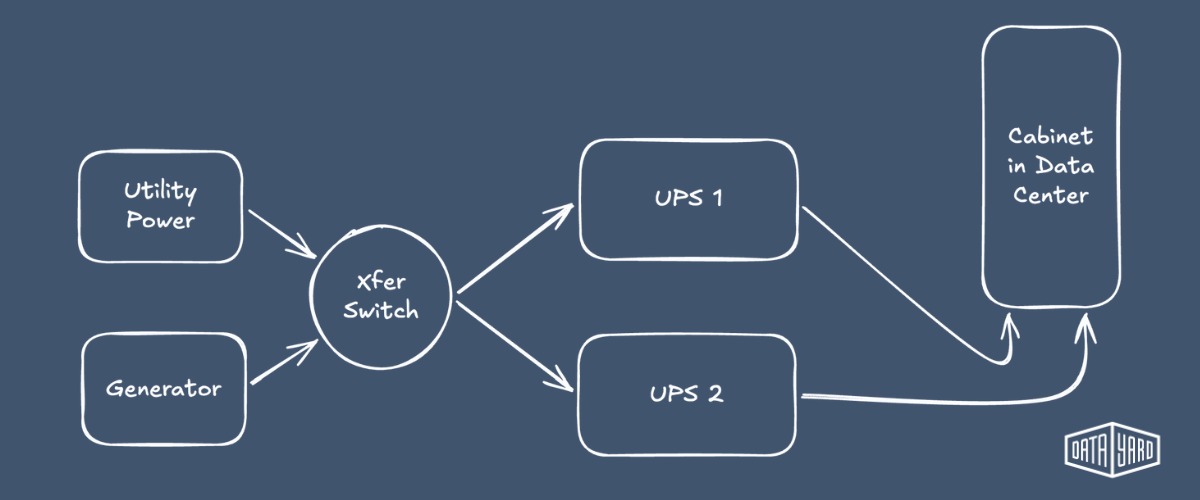
Effective data center power redundancy depends not only on the equipment in place, but also on how the overall system is designed, monitored, maintained, and tested.
Understanding Data Center Redundancy: N, N+1, and 2N
When evaluating a data center, you'll often see infrastructure redundancy described using "N notation."
N
Represents the capacity required to support normal operations without additional redundant capacity.
N+1
Provides the capacity required for normal operations, plus at least one additional component or unit of capacity. Depending on the overall system design, this additional capacity can allow required operations to continue when a component becomes unavailable.
2N
Generally refers to two independent systems, each designed with sufficient capacity to support the required load.
These terms describe different approaches to redundancy, but the notation alone doesn't provide a complete picture of a facility's resilience. How power sources, UPS systems, backup generation, transfer systems, monitoring, maintenance, and testing work together is also important.
The appropriate architecture depends on the facility, the workloads being supported, and an organization's availability requirements.
How DataYard Approaches Data Center Power Redundancy
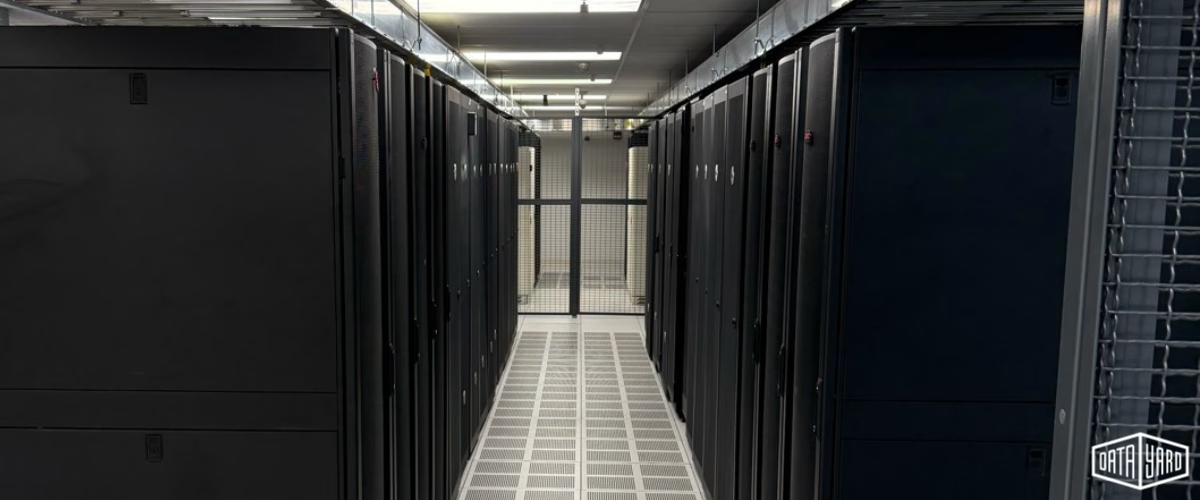
DataYard's Dayton data center uses multiple layers of infrastructure designed to support reliable operations.
Key infrastructure and facility attributes include:
- N+1 UPS systems
- N+1 power management modules, controlling two diverse utility power circuits
- N+1 cooling redundancy
- A natural gas generator for extended utility outages
- Four diverse fiber circuits, providing 40G+ to the internet
- A Tier 3 design
- SOC 2 Type 2 Accredited
Together, these systems and facility attributes support the physical infrastructure behind DataYard's private cloud environments and the equipment our colocation clients house within the facility.
Because the generator is connected to a natural gas supply, it eliminates reliance on onsite fuel storage and scheduled fuel deliveries as part of extended outage planning.
These systems are part of the infrastructure supporting DataYard's 99.999% uptime guarantee, as well as the organizations that depend on reliable access to business-critical systems.
What Data Center Power Redundancy Means for Cloud and Colocation Clients
Cloud services rely on physical infrastructure, whether that infrastructure is operated by a cloud provider, housed in a private data center, or distributed across multiple environments.
For clients running private cloud environments at DataYard, the facility's power, cooling, networking, and other systems provide the physical foundation for the servers' compute and storage resources supporting their workloads.
For colocation clients, the connection to the facility's physical infrastructure is direct. Their physical servers and networking equipment are housed within the data center and depend on the facility's power, cooling, connectivity, and security infrastructure.
Hybrid environments introduce additional considerations. Applications and data may span private infrastructure, colocated equipment, and / or public cloud platforms, with networks and services connecting those environments.
For organizations running business-critical systems, resilient facility infrastructure can help support:
- Continued operations during extended utility disruptions
- Backup power capability beyond UPS battery systems
- Business continuity and disaster recovery strategies that depend on reliable underlying infrastructure
Power redundancy alone doesn't create a complete business continuity or disaster recovery strategy. Applications, data, backups, replication, network connectivity, security, and documented recovery procedures all play a role, and resilient physical infrastructure provides an important foundation for those systems.
5 Questions to Ask About Data Center Power Redundancy
If you're evaluating a data center or colocation provider, understanding the facility's approach to power resilience can help you make a more informed decision.
Consider asking:
-
What happens if utility power is unavailable for an extended period?
Understanding how a facility is designed to operate beyond the immediate backup period provided by UPS systems can provide insight into its broader power resilience strategy.
-
What roles do UPS systems and backup generation play?
UPS and generator systems typically serve different purposes. Ask how they work together within the facility's overall power architecture.
-
How is backup generation supported during a prolonged utility disruption?
Ask about the facility's approach to generator runtime and how its fuel strategy supports extended outage planning.
-
How are transitions between power sources managed?
Understanding how the facility transitions from utility power to backup systems can help you evaluate the overall architecture.
-
How are redundant systems monitored, maintained, and tested?
Redundant equipment is only part of the equation. Ongoing monitoring, preventive maintenance, and testing are also important considerations when evaluating infrastructure resilience.
Clear answers to these questions can help you determine whether a facility's power architecture aligns with your organization's requirements for availability, continuity, and risk management.
Is Your Infrastructure Prepared for an Extended Utility Disruption?
The best time to understand your infrastructure's resilience is before a disruption occurs.
Whether your servers are located in your office, a colocation facility, or a private cloud environment, consider what would happen if utility power became unavailable for an extended period.
How long could your current infrastructure continue operating? What systems would be affected? How would a disruption affect your employees, customers, and business operations?
Understanding those dependencies can help you identify potential risks and determine whether your current infrastructure strategy provides the level of resilience your organization requires.
If you're uncertain how your current infrastructure would perform during a prolonged utility disruption, DataYard can help you evaluate your requirements and discuss practical options for improving resilience.
Frequently Asked Questions About Data Center Power Redundancy
What is data center power redundancy?
Data center power redundancy means that a facility has backup systems in place to reduce the risk that a single component failure or utility disruption affects operations.
Depending on the facility, the architecture may include UPS battery systems for immediate continuity, redundant power capacity, backup generation for longer outages, and systems designed to transition between available power sources.
How is generator backup different from UPS backup?
UPS systems provide immediate continuity when utility power is disrupted. Backup generators are designed to provide power during longer utility disruptions.
The two serve different but complementary roles within a data center's power architecture.
What power redundancy does DataYard's Dayton data center have?
DataYard's Dayton facility has N+1 UPS systems and power management modules, and redundant, A&B power feeds for client and internal use, fed by diverse power circuits.. The facility also has N+1 redundancy for all chiller and cooling equipment, as well as a natural gas generator designed to provide backup power capability during extended utility disruptions.
Why does DataYard use a natural gas generator?
A natural gas generator provides backup power capability during extended utility outages and is one component of DataYard's broader approach to infrastructure resilience at the Dayton facility.
How does power redundancy affect disaster recovery planning?
Power redundancy isn't a disaster recovery strategy by itself, but resilient facility infrastructure provides an important foundation for business continuity and disaster recovery planning.
Applications, backups, replication systems, storage, and network connectivity all depend on the infrastructure supporting them. Reducing exposure to facility-level power disruptions can help those systems remain available and operate as designed.
Does DataYard offer colocation services in Ohio?
Yes. DataYard provides colocation services from its data center in Dayton, Ohio, with flexible shared and dedicated cabinet options for organizations that need space for their server and networking equipment.
Clients can use DataYard's data center infrastructure while maintaining control of their own IT infrastructure and accessing local technical expertise.
Planning for Infrastructure Resilience?
Whether you're evaluating private cloud, colocation, or a hybrid environment, understanding the physical infrastructure behind your critical systems is an important part of planning for availability and continuity.
DataYard can help you evaluate your current environment, identify infrastructure requirements, and determine an approach that aligns with your workloads, availability needs, and long-term technology strategy.