
What Should Credit Union Website Hosting Provide?
Credit union website hosting provides the infrastructure that keeps a credit union's public website available to members and supports the applications, databases, content management system, and other services the website depends on.
The right hosting model will vary from one credit union to another. A relatively simple informational website has different requirements from a site with custom applications, third-party integrations, member forms, high traffic, or complex agency workflows.
Instead of choosing a hosting provider based on a single specification or monthly price, evaluate the complete environment.
Reliable Infrastructure
Ask how the infrastructure is designed, monitored, maintained, and supported to keep the website available. Reliability includes more than the server itself. Networking, storage, monitoring, maintenance, and access to technical support all contribute to the overall environment.
Clearly Defined Security Responsibilities
Determine who manages the firewall, operating system, patching, SSL certificates, DNS, access controls, and other infrastructure-level security responsibilities. These responsibilities can vary significantly between hosting models.
Backup and Recovery
Understand what is backed up, how frequently backups occur, how long they are retained, where they are stored, and how restoration works when something goes wrong.
Performance and Scalability
The environment should provide appropriate resources for normal usage while giving the organization a practical path for responding to increased traffic, application growth, or changing infrastructure requirements.
Responsive Technical Support
When a website has an infrastructure problem, the ability to reach people who understand the environment can be as important as the technology itself.
The key question isn't simply, "Where is our website hosted?" Ask who is responsible for keeping the infrastructure secure, available, monitored, supported, and recoverable when something goes wrong.
Some credit unions already own server or networking hardware and are weighing colocation instead of, or alongside, hosted infrastructure. The evaluation criteria above (reliability, security responsibilities, recovery, performance, and support) generally apply there too, even though colocation and website hosting solve different problems. If you're looking for credit union colocation, see DataYard Data Center Co-Location.
Why Credit Union Web Hosting Matters
A credit union's website is often one of the first places members go when they need information or access to digital services. It may direct members to online banking, provide branch and contact information, support applications and forms, publish important notices, and connect to third-party services.

That means an infrastructure issue can quickly become a member-experience issue. Slow performance, an outage, a security incident, or a failed website update can create confusion for members and additional work for internal teams and web partners.
Secure credit union website hosting should therefore be evaluated as part of the broader technology environment—not simply as a place to store website files.
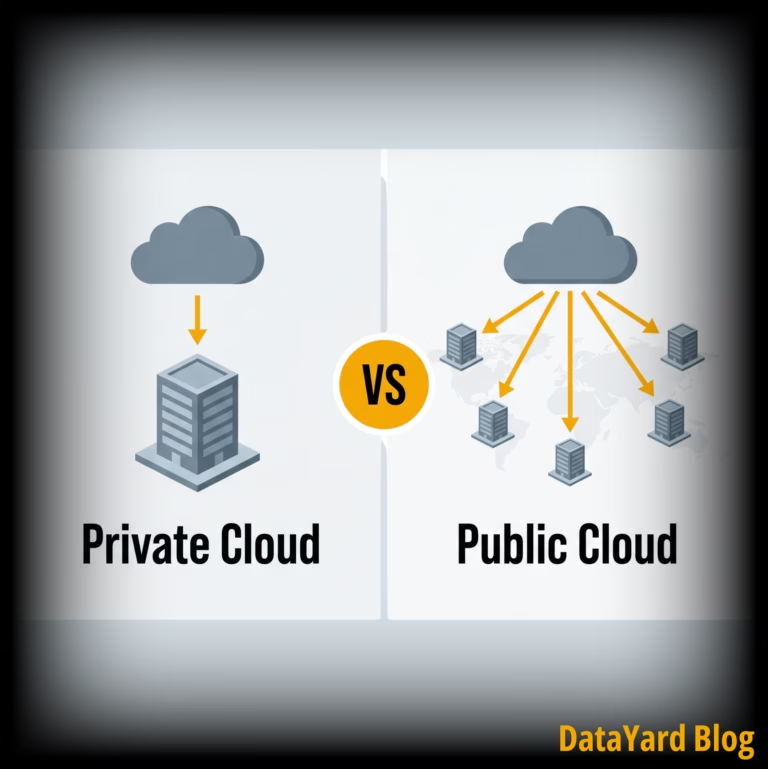
Shared hosting, unmanaged cloud infrastructure, managed public cloud, and private cloud can all have appropriate use cases. The important question is whether the hosting model matches the website's security, availability, recovery, performance, and support requirements.
Private Cloud Hosting for Credit Union Websites
Private cloud hosting can be a good fit when a credit union or its web development partner wants a more defined infrastructure environment with hands-on management and direct access to the team responsible for the underlying systems.
DataYard operates private cloud infrastructure from Dayton, Ohio and works with clients to tailor compute, memory, storage, networking, security, backup, and management around the needs of the workload.

Depending on the engagement, DataYard's role can extend beyond providing virtual server resources to include infrastructure monitoring, firewall management, SSL and DNS support, patching, backups, disaster recovery, and ongoing engineering assistance.
DataYard operates with a 99.999% uptime objective and provides Ohio-based 24/7/365 human support, giving clients and their development partners access to engineers when infrastructure issues require attention.
Private cloud is not automatically the right answer for every credit union website. The hosting decision should be based on workload, integrations, availability requirements, security responsibilities, recovery objectives, support needs, and expected growth.
Learn more about DataYard Private Cloud Hosting.
Backup and Disaster Recovery for Credit Union Website Hosting
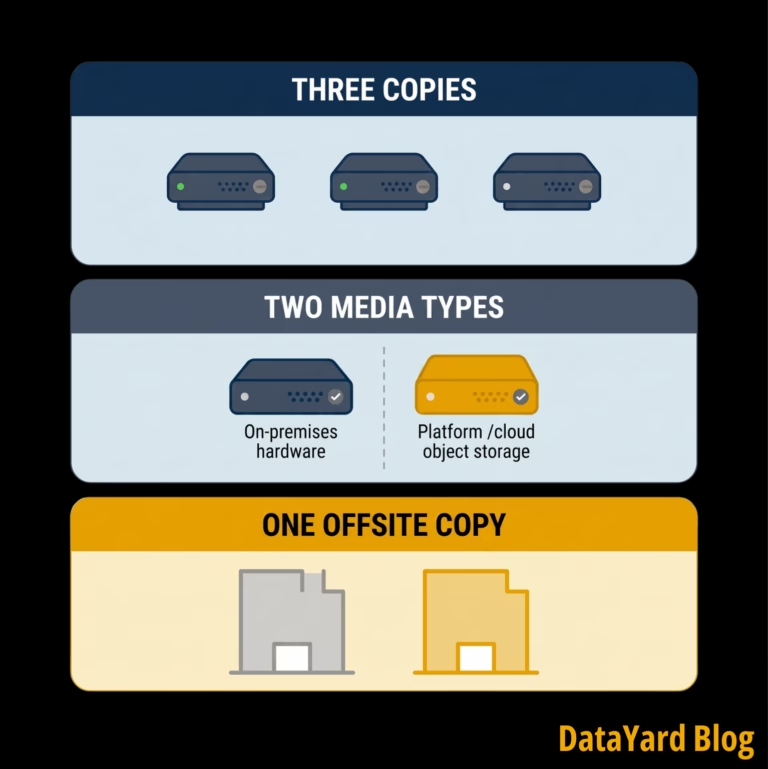
Cloud backup solutions are an important part of credit union web hosting, but having a backup is not the same as having a complete recovery plan.
A useful backup and disaster recovery conversation should define what needs to be protected, how frequently data needs to be captured, how long backups should be retained, and how quickly the website needs to be restored after an incident.
Questions to Ask About Website Backups
- Coverage: What website files, databases, configurations, and supporting systems are included?
- Frequency: How often are backups created?
- Retention: How long are backup copies retained?
- Storage: Where are the backup copies stored?
- Restoration: How is a restore requested and performed?
- Recovery expectations: How quickly should the website be recoverable?
- Testing: Are recovery procedures periodically reviewed or tested?
These website-level requirements should also be distinguished from the credit union's broader organizational backup strategy. Protecting a public website does not necessarily mean every business system, endpoint, file share, or core application is covered by the same backup process.
Backups answer, "Do we have a copy?" Disaster recovery planning goes further by defining how those copies and the supporting infrastructure will be used to restore service within an acceptable timeframe.
Web Hosting for Credit Unions and Financial Institutions
Financial institutions evaluating web hosting should consider both the technology and the operating relationship behind it. Infrastructure requirements may include availability, access controls, monitoring, backups, recovery planning, change management, documentation, and clearly assigned responsibilities.
The appropriate controls depend on the website, the data it handles, its integrations, and the institution's own vendor-management and security requirements.
Hosting alone does not make a website compliant. A hosting provider should be able to clearly explain which responsibilities it manages and which remain with the credit union or its development partner.
Hosting for Web Agencies and Developers Serving Credit Unions
Credit unions do not have to choose between keeping a trusted web development partner and using a specialized infrastructure provider. The two can work together.
The Web Partner
A web agency or development firm can remain focused on website strategy, design, development, content, CMS management, integrations, releases, and the member-facing experience.
The Infrastructure Partner
The infrastructure partner can focus on hosting, networking, monitoring, infrastructure security, backups, recovery, and the underlying systems supporting the website.
The exact division of responsibility should be documented so the credit union, agency, and infrastructure provider know who owns each part of the environment.
Credit Union Website Hosting in Practice
This agency-and-infrastructure model is already being used in practice.
DataYard + Level9
Level9 develops websites and software for credit unions, community banks, and other financial-services organizations. As its client base grew, the company needed infrastructure that could support its web platforms while giving its team access to responsive technical support.
DataYard worked with Level9 to provide a dedicated Linux-based private cloud environment and ongoing infrastructure support.
- Private cloud: Dedicated Linux-based private cloud infrastructure.
- Network security: Next-generation firewall policies.
- Cloudflare: Cloudflare Pro.
- Management: 24/7/365 infrastructure management and monitoring.
- Recovery: Disaster recovery backups.
This division of responsibility allows Level9 to focus on building and supporting its clients' web experiences while DataYard manages the infrastructure layer behind a growing number of those platforms.
7 Questions to Ask a Credit Union Website Hosting Provider
When evaluating credit union web hosting, use the conversation to understand how the environment will actually be managed after deployment.
-
Where will the website run, and who manages the infrastructure?
Understand the hosting architecture and which organization is responsible for the underlying environment. -
Who manages the operating system, firewall, SSL certificates, DNS, and patching?
Do not assume these responsibilities are included simply because an environment is described as managed hosting. -
What happens when there is a problem after normal business hours?
Ask how monitoring, escalation, and technical support work during an incident. -
How are backups and recovery handled?
Document backup frequency, retention, storage, restoration procedures, and recovery expectations. -
How does the environment handle traffic changes?
Discuss normal traffic, expected peaks, planned campaigns, unusual events, and how additional capacity can be introduced if needed. -
What documentation is available?
Determine what information the provider can supply to support vendor-management, security, and internal review processes. -
Can our web agency work directly with the infrastructure team?
Direct collaboration can make troubleshooting, deployments, migrations, and infrastructure changes more efficient.
Look for specific answers rather than broad promises. A provider should be able to explain how monitoring, support, backups, recovery, security responsibilities, and escalation work in the environment being proposed.
How DataYard Supports Credit Union Website Hosting
DataYard has supported business infrastructure from Ohio since 1995. Today, our team designs, hosts, secures, monitors, and manages cloud infrastructure while also supporting organizations using public and hybrid cloud environments.
For credit unions and the agencies that serve them, that can mean building a hosting environment around the actual website rather than forcing the application into a one-size-fits-all hosting package.
Depending on the engagement, DataYard can support:
- Private cloud hosting tailored to the workload.
- Cloud infrastructure management and ongoing monitoring.
- Networking and firewall management.
- Backup and disaster recovery.
- AWS and Azure environments.
- Cloudflare configuration and support.
- Infrastructure planning and modernization.
- Direct collaboration with web agencies and development teams.
- Ohio-based 24/7/365 human support.
Learn more about DataYard Cloud Management & Strategic Consulting.
Frequently Asked Questions
What Is Credit Union Web Hosting?
Credit union web hosting is the infrastructure used to run a credit union's website and its supporting applications, databases, content management system, and related services. The hosting model should be evaluated based on the website's performance, security, availability, recovery, and support requirements.
What Should a Credit Union Look for in Website Hosting?
Look at infrastructure reliability, monitoring, security responsibilities, backup and disaster recovery processes, performance, technical support, scalability, documentation, and how responsibilities are divided between the credit union, hosting provider, and web development partner.
Does a Credit Union Website Need Private Cloud Hosting?
Not necessarily. Private cloud can be appropriate when a credit union or its development partner benefits from dedicated resources, greater environmental control, predictable infrastructure, or hands-on management. Public and hybrid cloud environments can also be appropriate depending on the workload.
What Backup Solutions Should a Credit Union Website Have?
The appropriate backup approach depends on the website and its recovery requirements. Important considerations include what is backed up, backup frequency, retention, storage location, restoration procedures, and the recovery time and recovery point the organization requires.
Can a Credit Union Keep Its Current Web Development Agency?
Yes. The web agency can continue managing design, development, content, applications, and the member-facing experience while a separate infrastructure provider manages the cloud environment, networking, monitoring, backups, and other agreed infrastructure responsibilities.
Does DataYard Support WordPress Websites?
DataYard can provide and manage infrastructure for WordPress and other web applications. The exact responsibilities for the CMS, plugins, application code, operating system, and infrastructure should be defined as part of the hosting engagement.
Where Does DataYard Host Private Cloud Infrastructure?
DataYard operates private cloud infrastructure from Dayton, Ohio and provides access to an Ohio-based technical team for ongoing infrastructure support.
Related pages: Private Cloud Hosting | Cloud Management & Strategic Consulting | Data Backup & Recovery | Level9 Case Study