AI isn't rewriting the cybersecurity playbook, but it is speeding up every page of it. In this blog, we break down what is changing on each side, why speed has become such an important factor, and what businesses can do about it, whether they have no IT team, a small one, or a larger department.
What Are AI Cyberattacks?
The phrase "AI cyberattack" sounds like something out of a movie, but it's quickly becoming reality. In practice, an AI cyberattack is any attack where criminals use artificial intelligence to plan, carry out, or scale their work,a from writing phishing emails to finding software flaws. Most of the time, AI is making familiar attack methods faster, cheaper, and easier to scale.
It also helps to separate two kinds of AI risk. The first comes from how your own people use AI tools, like pasting a client contract or source code into a public chatbot, where, depending on the tool and its settings, that confidential data may be stored or used in ways you can't control. The second comes from weaknesses in AI systems themselves, which attackers can exploit to expose data or skew results. For most businesses, Huntress notes (opens in a new tab), the first kind is the more common day-to-day risk.
Common Types of AI Cyberattacks
Verizon's 2026 Data Breach Investigations Report (DBIR) (opens in a new tab) (which covers incidents from October 2024 through November 2025) found that threat actors are using generative AI (GenAI) at several stages of an attack, from choosing targets to developing malware. Across the latest threat reports, these AI cyberattacks tend to fall into a few common types:
- AI-written phishing and deepfakes. Attackers use AI to research targets and write convincing, personalized messages, often without the awkward wording or typos that used to give scams away. Some go even further by including a deepfake audio or video of someone the target trusts, like a manager asking for an urgent payment. IBM found (opens in a new tab) that one in four malicious breaches in its 2026 study were AI-enabled, a 56% increase over the previous year, led by deepfake impersonation and AI-enabled malware.
- AI-assisted malware. Attackers use GenAI to help write and adjust malware and other attack tools. Most of it still does what existing malware already does: Verizon found (opens in a new tab) that less than 2.5% of AI-assisted malware observations involved less-common techniques. The difference here is: the addition of AI allows the malware to work even faster.
- AI-assisted vulnerability research. AI helps attackers find and use software flaws faster, and it lets them go further than their own human skills would normally allow. According to CrowdStrike (opens in a new tab), AI lets adversaries "enhance their capabilities and adopt techniques beyond their existing areas of expertise."
- Autonomous AI agents. Some attackers now hand entire cyberattack campaigns to AI agents that run with little human involvement. According to Fortune (opens in a new tab), in September of 2026, a hacker used AI agents to attempt break-ins at more than 1,200 websites over several weeks, with no additional human work required once the agents were launched. Citing Reuters, which first reported the incident, Fortune said the agents successfully breached about 100 companies, including farm equipment maker Deere and engine manufacturer Cummins, at a cost of roughly $50 in AI tools per successful breach. "These AI systems are now both more capable of hacking and are able to act more autonomously," Jessica Ji, a senior research analyst at Georgetown's Center for Security and Emerging Technology (CSET), told Fortune.
- Attacks on AI tools. As businesses adopt AI, the tools themselves become targets. CrowdStrike found (opens in a new tab) that attackers injected malicious prompts into legitimate GenAI tools at more than 90 organizations, and more than 20% of organizations in IBM's study (opens in a new tab) reported a breach that targeted AI models or applications. One type, "AI Model Inversion," occurs when attackers pull sensitive training data back out of an AI model. These types of attacks cost an average of $6 million per breach.
- Shadow AI and data exposure. Not every AI risk comes from an attacker. Verizon found (opens in a new tab) that 45% of employees now regularly use AI tools on their work devices -- that's up from 15% the year before. Not only that, but it's reported that 67% of these users access AI services through non-corporate accounts. Source code was the most common type of data submitted to unauthorized AI tools, which poses a significant security risk when left unchecked.
Outside of attacks on AI tools themselves, AI isn't creating many entirely new categories of attacks (at least not yet). The UK's National Cyber Security Centre (NCSC) (opens in a new tab) projected that through 2027, AI will likely increase the volume and impact of cyber intrusions by primarily enhancing existing methods, rather than creating new ones.
That's both good and bad news. The good news is that companies already know how to defend against many of these attacks. The bad news is that they now have to do it faster than ever. And that doesn't mean attackers won't find new ways to use AI, so staying on top of these changes matters.
How AI Cyberattacks Affect Businesses
Most of us have heard that cyberattacks, AI-assisted or not, are becoming more frequent. What's easier to overlook is how far the damage can reach:
- Financial cost. IBM found (opens in a new tab) that the average global cost of a data breach reached a record $4.99 million, a 12% increase over the year before. Breach costs also vary by industry, with averages of $6.3 million for financial services and $5.2 million for energy. Because so many other organizations depend on these industries, a breach in either one can have a domino effect, rippling out across the economy, supply chains, and essential services like banking and power.
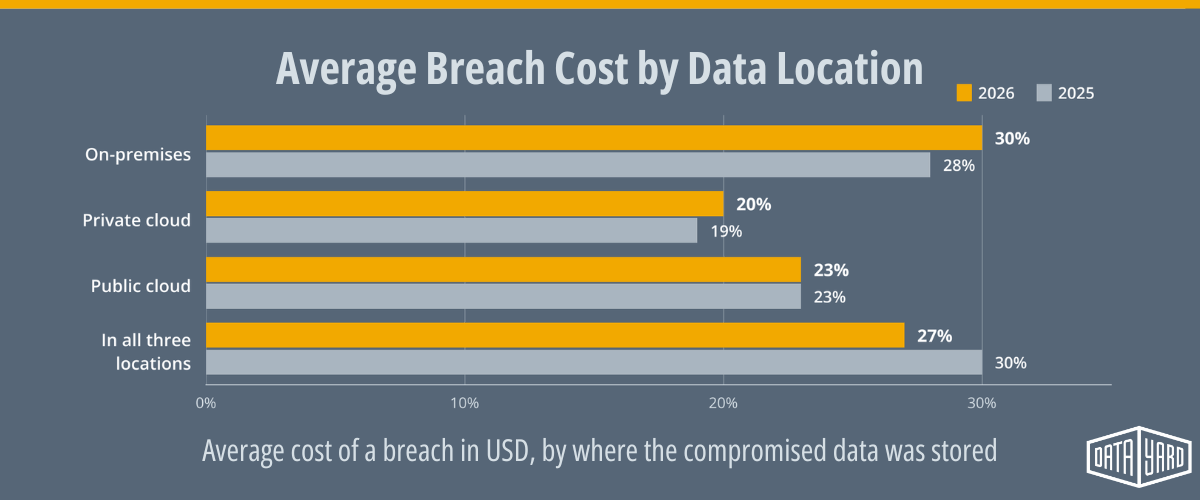
- Data exposure. IBM found (opens in a new tab) that 52% of breaches involved compromised customer personally identifiable information (PII), and its data shows increases in compromised data across on-premises, private cloud, and public cloud environments (see figure below). In other words, no environment is safe just because of where it lives. What matters most is how well it's secured, maintained, and monitored.
- Operational disruption. Verizon found (opens in a new tab) that ransomware was involved in 48% of breaches, and an attack that locks up systems can stop production, shipping, or service until things have been restored.
- Lost trust. A security breach can shake the confidence of customers, employees, and partners, and in some cases, it can threaten whether a business survives at all.
The chart below breaks down IBM's 2025 and 2026 findings by where the compromised data was stored: on-premises, private cloud, public cloud, or all three.
When thinking through all of this, the true cost of a breach often reaches well beyond the initial remediation project. And as attacks get faster, businesses have less time to stop one before that damage starts.
Why Speed Is the Biggest Change
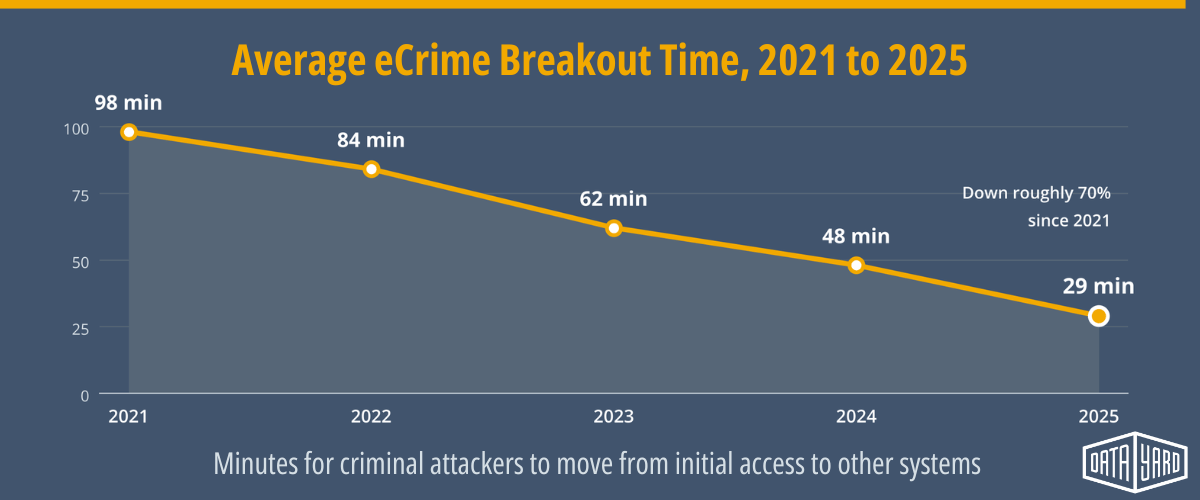
The clearest signal of how AI is changing cyberattacks is: time. According to the 2026 CrowdStrike Global Threat Report (opens in a new tab), the average breakout time for criminal attackers (the time between a hacker gaining initial access and them moving on to other systems in the network) fell to 29 minutes in 2025, a 65% increase in speed from 2024. Since 2021, average breakout time has dropped by roughly 70%, a sign that attackers are getting much faster at expanding their foothold after initial access.
The chart below shows how CrowdStrike's average eCrime breakout time has changed since 2021, falling from 98 minutes to 29 minutes in 2025.
Attackers are also harder to spot. CrowdStrike found (opens in a new tab) that 82% of its detections in 2025 were malware-free, up from 51% in 2020, meaning attackers often relied on legitimate tools and access methods that blend in with the business' normal activity, rather than malicious files.
The window for patching systems is shrinking as well:
- Vulnerabilities are now the most common way in. Verizon found (opens in a new tab) that exploiting software vulnerabilities was the most common initial access vector for breaches, at 31%, compared to 13% for stolen or abused credentials (see image below). In manufacturing breaches, that number was even higher, at 38%.
- Some flaws are exploited before anyone knows they exist. CrowdStrike saw (opens in a new tab) a 42% year-over-year increase in zero-day vulnerabilities exploited before public disclosure, which means there was no patch to install yet. In those cases, monitoring for suspicious behavior is what can catch an attack.
The chart below shows how the most common initial access vectors have shifted across the last five editions of Verizon's report. Each year on the chart reflects the edition of the report, not the year the incidents happened.
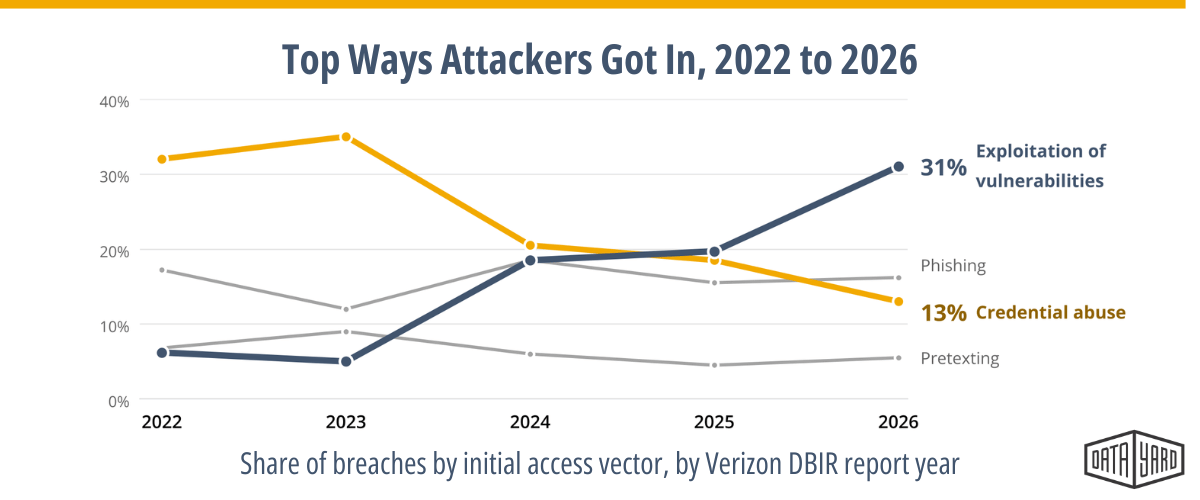
Keep in mind that the Verizon 2026 report (opens in a new tab) covers incidents from October 2024 through November 2025, before much of the most recent AI acceleration, so these figures don't prove that AI alone is driving the rise in exploitation. What they do show is that the gap between "a fix is available" and "the fix is installed" is where many breaches start, and AI is likely only going to make that gap more expensive.
How AI in Cybersecurity Is Helping Defenders (and Where It Falls Short)
We know all of this can sound scary. The good news is, faster attacks are only half the story. The same technology is also changing how defenders work. IBM found (opens in a new tab) that organizations making extensive use of AI and automation in their cybersecurity operations saved an average of $1.93 million in breach costs. Even so, one in four organizations in the study had not yet adopted these tools.
On the defense side, AI and automation are most often used to help detect and contain threats faster. According to Huntress (opens in a new tab), security teams use AI to sort through large volumes of log data and filter out false alarms, so analysts can spend their time on real threats. IBM reported (opens in a new tab) that more than half of organizations use AI agents for threat detection and containment, but only 18% apply them to vulnerability management. That leaves known weaknesses open even as attackers move faster, and it's one of the clearest places where defenders can still catch up.
Where AI on Defense Falls Short
AI can be a very helpful tool for defenders, but it isn't a complete answer on its own. Here are a few ways AI on defense can fall short:
- It can stall at the worst moment. When the coding platform OpenCode came under an autonomous AI attack in October 2026, the AI model it was using to defend itself started refusing requests in the middle of the attack, Fortune reported (opens in a new tab). Hugging Face ran into a similar problem in July 2026.
- The same capability cuts both ways. AI that helps defenders find vulnerabilities can help attackers find them, too.
- Tools alone aren't enough. Michael Siegel, director of Cybersecurity at MIT Sloan (opens in a new tab), has said that AI-powered cybersecurity tools alone won't be enough. MIT Sloan's approach to cybersecurity pairs AI tools with automated security hygiene, autonomous and deceptive defense systems, and human oversight.
On the other hand, CrowdStrike notes (opens in a new tab) that human-only analysis also struggles to keep pace with attacks this fast. That's why many of the strongest setups pair AI-assisted detection with people who can investigate and respond. An alert at 2AM is only useful if there's a person, or a managed team, who can act on it. The NCSC (opens in a new tab) warns of a growing "digital divide" between organizations that can keep pace with AI-enabled threats and those that fall behind.
For smaller organizations with little or no internal IT team, the practical path across that divide doesn't have to be building an in-house security operations center (SOC), which can be expensive. It can be partnering with a team that already does this work, which is where Managed EDR comes in.
How DataYard's Managed EDR Works
Managed endpoint detection and response (mEDR) watches how devices like laptops, desktops, and servers behave, rather than only checking signatures against a list of known threats like traditional antivirus does. Think of antivirus as a lock on the door, and EDR as the camera, the alarm system, and the response team, all running at once. Each does different jobs; while antivirus protects against known attacks, managed EDR can catch what gets past AV. Plus, mEDR also adds the people aspect: trained analysts who investigate alerts and help respond around the clock.
DataYard's Managed EDR is powered by Huntress (opens in a new tab) on the backend and supported by our Ohio-based engineers. Huntress monitors your endpoints (workstations, laptops, servers, and remote employees' devices) around the clock for suspicious activity. When something is flagged, Huntress's human-led, AI-assisted security operations center investigates, and DataYard's team is alerted to work with you on the response. Here's how it works:
- The threat is detected. Suspicious behavior is flagged across your endpoints in real time.
- An analyst investigates. A security analyst reviews the alert and determines whether it's a real threat.
- The threat is contained. The affected endpoint can be isolated to stop an attacker from moving to other systems.
- You're informed. You get a clear incident report, and DataYard's team works with yours on next steps.
What that looks like in practice: In one recent case, an unauthorized remote management tool was downloaded and run on a client's computer. Behavioral EDR monitoring flagged it, and the endpoint (a laptop) was isolated from the network when the alert fired.
DataYard notified the client within 12 minutes, and the issue was fully resolved 52 minutes after the alert, the same afternoon it started, with the threat contained to that one device. Without that kind of monitoring, an intrusion like this can go unnoticed for much longer, giving an attacker time to spread across the business. You can read the full timeline in our Managed EDR case study.
A Recent Example: The October 2026 PHP Security Issue
This vulnerability wasn't AI-driven, but it shows what that race against the clock looks like in practice.
On October 20, 2026, the PHP security team announced (opens in a new tab) a critical vulnerability that affects all versions of PHP going back to version 5.4. The flaw creates a path for remote code execution (RCE), which can allow attackers to open webshells on an affected server. PHP scheduled its patch release for the next morning, October 21, at 10 AM ET.
Before the patch was available, DataYard applied the recommended php.ini mitigation for customers with known PHP installations. Once the patch was released, our team patched critical DataYard infrastructure and managed cloud customer environments, then worked through the remaining hosted websites. You can read the full details in our Critical PHP Security Issue 10/21/2026 post.
It's a good example of how short the window between a public announcement and a patch can be, and why having a plan to patch quickly matters.
What to Do About It
What this all means in practice depends a lot on the size of your IT team.
Businesses With No IT Team
Many small businesses don't have a dedicated IT person on staff. Technology solutions might be handled by the owner, an office manager, or an outside vendor who comes in when something breaks. For these businesses, the biggest risk often isn't a sophisticated AI attack; rather, it's that no one will notice an attack until the damage is already done. Verizon found (opens in a new tab) that small businesses are disproportionately affected by ransomware, typically because they have fewer resources available to respond.
The good news is that the first steps don't require an entire IT department. CISA's Secure Our World program (opens in a new tab) focuses on four basics for individuals and small businesses:
- Use strong passwords and a password manager
- Turn on multi-factor authentication (MFA)
- Train employees to recognize and report phishing
- Update software, and turn on automatic updates where you can
Beyond those basics, it's worth knowing exactly who is responsible for your technology. If an outside vendor manages your systems, CISA recommends (opens in a new tab) talking with them about how they keep their software updated. If no one is watching your systems after hours, a managed provider can help fill that gap without hiring a full-time team.
Businesses With Small IT Teams
Many organizations, especially in manufacturing, run with one or two IT people who are responsible for everything. Keeping up with AI-assisted attackers running around the clock isn't realistic for a team of that size, but it doesn't have to be. You don't have to outrun every AI-powered attacker. You just don't want to be the easiest target on the block. As Verizon (opens in a new tab) put it in this year's report, the answer is "refinement, not revolution."
Here are the steps that can make the biggest difference:
- Shorten your patching window. Keep an inventory of the hardware and software in your organization, and turn on automatic updates where you can, as CISA recommends (opens in a new tab) for businesses. Prioritize vulnerabilities on the CISA KEV list (opens in a new tab), since those are already being used in real attacks.
- Make sure someone (or something) is watching 24/7. When attackers can move between systems in minutes, timely monitoring and response matter. Managed EDR, covered above, is one way to get that coverage without building an in-house SOC.
- Lock down access. Apply multi-factor authentication (MFA) everywhere possible, make sure employees are using strong passwords, and follow zero-trust policies that limit what each user and device can reach. When employees leave, remove their access right away.
- Train employees to spot social engineering. AI is helping to make impersonation more convincing, and Verizon found (opens in a new tab) that phishing simulations through phone calls and text messages were about 40% more successful than email. Make end-user cybersecurity awareness training a regular business habit, and make it easy to report suspicious messages. For requests involving payments, payroll changes, or passwords, make sure your team knows to confirm the request through a separate channel (like calling a known phone number or talking face-to-face) before acting.
- Keep tested backups that ransomware can't reach. Regularly test restores so you know your backups work as expected. Immutable offsite backups are more important than ever, and are now included in all DataYard data backup and recovery services.
- Set clear rules for AI use at work. Employees can expose sensitive information by entering customer data, contracts, or source code into unapproved AI tools. Decide which AI tools are approved and what information should never be shared with them.
None of these steps are new, and that's the point. Boring, well-tested basics often beat flashy tools, and while AI is raising the speed of cyberattacks, these fundamentals are still what the success or failure of many breaches comes down to.
Businesses With Medium to Large IT Teams
Larger IT teams usually have the basics in place. Their challenge with AI cyberattacks tends to be scale: more systems, more vendors, more AI tools, and more alerts than any single team can work through by hand. A few areas deserve extra attention:
- Patching at scale. More systems mean more patches to track. Prioritize the CISA KEV list (opens in a new tab), and look for ways to automate vulnerability management, an area where IBM found (opens in a new tab) AI adoption still lags.
- Third-party access. Verizon found (opens in a new tab) that third parties were involved in 48% of total breaches, up 60% from the year before. Regularly review which vendors can reach your systems and how they secure that access.
- Movement across environments. CrowdStrike observed (opens in a new tab) attackers moving quickly across servers, hypervisors, cloud environments, unmanaged devices, and software-as-a-service (SaaS) applications, so monitoring that only covers one part of your environment can leave gaps.
- Your own AI tools. Treat AI tools and agents like any other system: inventory them, limit their permissions, and monitor them.
- Practice for AI-speed attacks. Michael Siegel of MIT Sloan (opens in a new tab) recommends AI-driven threat simulations, and tabletop exercises built around short breakout times can show whether your response plan holds up when you have minutes, not hours.
Even larger teams sometimes bring in a partner for after-hours coverage or specialized workloads, so in-house staff can focus on higher-priority work.
Cybersecurity Is Ongoing Work
The common thread across all of this is that cybersecurity isn't a one-time project. For many businesses, the strongest protection comes from infrastructure that's actively maintained: patched on a regular schedule, monitored, backed up, and supported by people who can respond when something looks wrong.
That's the approach behind DataYard's managed cloud services. Environments are deployed with cybersecurity best practices for user access and credentials, and can include ongoing patching, monitoring, and regular backups so you can roll back quickly. Additional protections, like next-generation firewall policies, managed endpoint detection and response, web application firewalls, immutable backups, and security reporting, can be added based on your needs.
Frequently Asked Questions
What Are AI Cyberattacks?
AI cyberattacks are attacks where criminals use artificial intelligence to plan, carry out, or scale an attack, such as writing phishing messages, impersonating people with deepfakes, or researching software vulnerabilities. The term can also cover attacks on AI tools themselves, like the malicious prompts CrowdStrike (opens in a new tab) found injected into legitimate GenAI tools at more than 90 organizations.
Is AI Creating New Types of Cyberattacks?
At the time of this article, the answer is mostly no. Both Verizon's 2026 DBIR (opens in a new tab) and the NCSC (opens in a new tab) found that AI is mainly helping attackers carry out familiar techniques faster and at a larger scale. Another change is how much of an attack can run on its own. The NCSC assessed in 2025 that fully automated, end-to-end advanced attacks were unlikely before 2027, but Fortune reported (opens in a new tab) in October 2026 that attackers are already using AI agents to run large campaigns with little human involvement.
What Is Breakout Time?
Breakout time is how long it takes an attacker to move from the first system they compromise to other systems in the same network. CrowdStrike reported (opens in a new tab) an average breakout time of 29 minutes for criminal attackers in 2025, which means the window to detect and contain an intrusion can be very short.
Should We Block Employees From Using AI Tools?
Not necessarily. Many employees already use AI tools at work, and Verizon found (opens in a new tab) that 67% of users access AI services through non-corporate accounts on their work devices. A ban may push even more of that use out of view. A clear policy on which AI tools are approved, and what types of data should never be shared with them, can be a more practical approach.
Disclaimer: This blog is intended for general informational purposes and is not a substitute for a professional cybersecurity assessment. Every environment is different, and the right steps for your organization may vary. Statistics and findings come from the third-party reports listed below and reflect information available as of October 2026. Because the threat landscape changes quickly, some figures may change as new research is released.