
Cloud cost optimization is not simply about spending less. The goal is to remove waste, match resources to real demand, and control costs without creating performance or reliability problems somewhere else.
Cloud environments make it easy to add compute, storage, databases, networking, and other resources as needs change. Over time, that flexibility can also make it difficult to see exactly where money is going and whether every resource is still delivering value.
A better approach starts with visibility. From there, businesses can eliminate unnecessary resources, right-size workloads, optimize cloud storage, evaluate capacity commitments, and put practical controls in place to prevent costs from creeping back up.
This cloud cost optimization playbook provides a practical framework for reducing unnecessary spend while keeping performance, reliability, recovery requirements, and business needs in the decision.
Originally published January 12, 2026. Updated September 2026.
- Start with visibility before reducing resources or changing architecture.
- Eliminate obvious waste before making deeper performance-sensitive changes.
- Right-size workloads using real utilization data and defined performance guardrails.
- Optimize cloud storage based on access patterns, retention needs, and recovery requirements.
- Use commitments for predictable baseline demand only after right-sizing.
- Review whether each workload is running in the cloud environment that best fits its technical and financial requirements.
- Treat cloud cost optimization as an ongoing operating practice, not a one-time cost-cutting exercise.
What Is Cloud Cost Optimization?
Cloud cost optimization is the ongoing process of aligning cloud spending with the resources, performance, reliability, and business outcomes an organization actually needs.
That distinction matters. Reducing a cloud bill is relatively easy if the only goal is to spend less. Resources can be removed, instances can be downsized, storage can be moved to lower-cost tiers, and capacity can be reduced.
The harder task is reducing unnecessary cost without creating a new problem in application performance, availability, recovery time, security, or engineering workload.
Why Cloud Cost Optimization Goes Wrong
Cloud environments can grow incrementally. A development environment stays online. A volume is detached but never deleted. Snapshots accumulate. A database is provisioned for a peak that no longer exists. A team adds resources for a project and nobody revisits them after the project ends.
Individually, those decisions may seem small. Across an environment, they can create meaningful unnecessary spend.
Problems arise when businesses respond by cutting capacity before understanding why it exists. An oversized resource may be wasteful, but it may also be protecting against seasonal traffic, batch processing, memory pressure, or another workload characteristic that is not obvious from a single utilization snapshot.
Effective cloud cost optimization therefore starts with understanding the environment before changing it.
7 Steps for Cloud Cost Optimization Without Sacrificing Performance
Get visibility into cloud spending
Review 30–90 days of billing and utilization data and identify the services responsible for the largest share of spend. Map those resources to applications, environments, owners, and business functions wherever possible.
For seasonal or highly variable workloads, use a longer period so your analysis includes representative peaks rather than only quiet periods.
Eliminate low-risk cloud waste
Start with resources that can often be addressed without affecting the production user experience: idle development environments, orphaned storage, outdated snapshots, unused network resources, and temporary infrastructure that is no longer temporary.
Low-risk cleanup creates savings while giving the team time to investigate more complex optimization opportunities.
Right-size resources with performance guardrails
Right-sizing should match capacity to actual demand rather than simply making resources smaller. Review CPU, memory, storage, latency, error rates, queue depth, database behavior, and other workload-specific signals before changing capacity.
Make changes incrementally and define rollback thresholds before implementation. If performance deteriorates beyond an acceptable threshold, restore the previous configuration and reassess.
Make smarter capacity commitments
Reserved capacity and savings programs can make sense for workloads with predictable baseline usage. The important sequence is to remove waste and right-size first, then evaluate which portion of demand is stable enough to justify a longer commitment.
Keep variable or seasonal capacity flexible where the business benefits from scaling up and down.
Optimize cloud storage costs
Storage costs can grow quietly as backups, snapshots, logs, replicated data, and older files accumulate. Review storage based on access frequency, retention requirements, recovery objectives, and data movement costs rather than treating every dataset the same.
Control cloud sprawl with practical governance
Optimization is temporary if unnecessary resources immediately return. Use resource ownership, tagging, budgets, alerts, approved deployment patterns, and shutdown policies to make efficient behavior part of normal operations.
Measure reliability alongside cost
Lower spend is not a successful outcome if users experience slower applications, increased errors, missed recovery objectives, or more downtime. Track performance and reliability metrics alongside cost so optimization decisions can be evaluated as a whole.
Cloud Storage Cost Optimization
Storage deserves specific attention because it can grow without creating the same immediate visibility as compute. Backups, snapshots, logs, replicated datasets, database storage, and project files can accumulate over time.
Cloud storage cost optimization starts by matching data to how the business actually uses it.
Frequently Accessed
Active data may require fast access and low latency. Cost matters, but moving it to a slower tier simply to reduce the storage rate can affect application performance.
Occasionally Accessed
Data used less frequently may be a candidate for lower-cost storage, provided retrieval behavior still matches operational requirements.
Archive & Retention
Infrequently accessed data may fit archival storage, but retrieval times, retention requirements, restore costs, and recovery objectives still need to be considered.
Before changing a storage tier or backup policy, understand the recovery time objective (RTO), recovery point objective (RPO), retention requirements, retrieval behavior, and potential data movement charges associated with that data.
Is the Workload Running in the Right Cloud Environment?
Cloud cost optimization should not stop at individual resources. Sometimes the larger opportunity is architectural: determining whether a workload is running in the environment that best matches its demand, performance requirements, management needs, and cost profile.
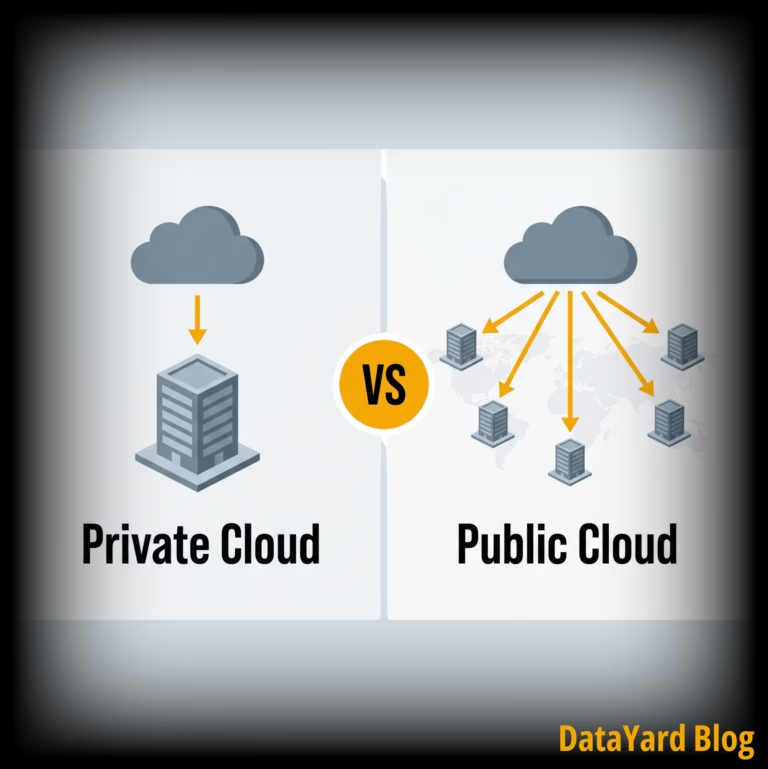
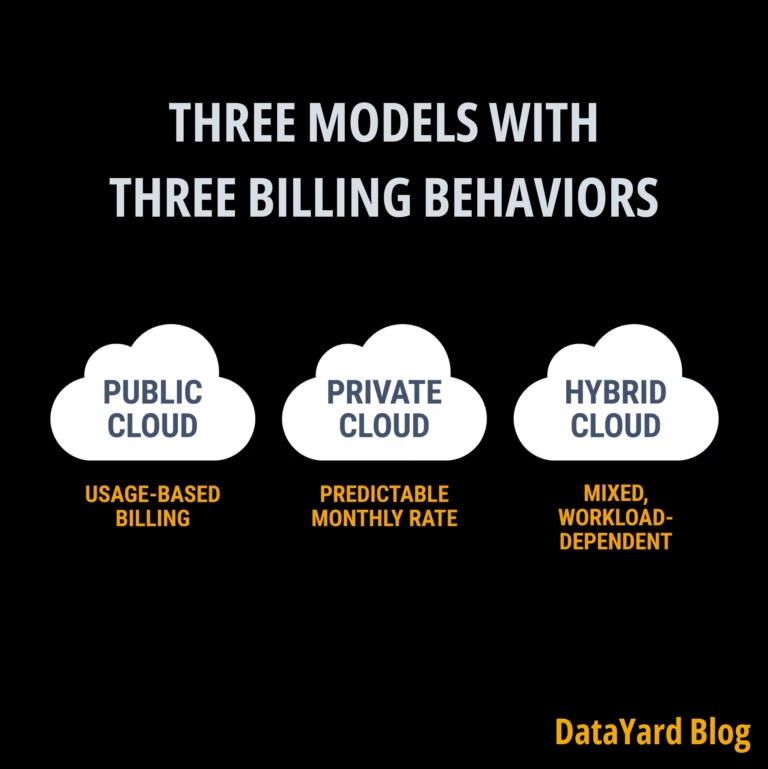
Public cloud, private cloud, and hybrid environments can each be appropriate depending on the workload. The goal is not to force everything into one model. It is to understand what the application needs and choose infrastructure accordingly.
Public Cloud
AWS and Azure can provide extensive services and flexible capacity for workloads that benefit from elasticity, distributed infrastructure, or cloud-native capabilities.
Private Cloud
Predictable workloads may benefit from private cloud infrastructure when consistent resources, predictable billing, direct engineering support, or greater environmental control are priorities.
Hybrid Cloud
A hybrid strategy can place different workloads where they make the most operational and financial sense instead of requiring the entire business to use one infrastructure model.
DataYard works across private cloud, AWS, Azure, and hybrid environments, allowing cloud optimization conversations to include both resource-level improvements and the broader question of where workloads should run.
Learn more about DataYard's Cloud Management & Strategic Consulting or explore our private cloud hosting.
A 30-Day Cloud Cost Optimization Checklist
Cloud cost optimization becomes easier to manage when the work is broken into a short sequence rather than approached as a single large project.
Week 1: Visibility and Ownership
Review billing and usage data, identify the largest cost drivers, map resources to owners and applications, and flag areas where ownership or purpose is unclear.
Week 2: Waste Cleanup
Review idle non-production environments, unattached resources, outdated snapshots, unnecessary storage, and unused network services. Verify dependencies before removal.
Week 3: Right-Sizing and Storage
Evaluate high-cost, underutilized resources using representative performance data. Review storage tiers, backup retention, and recovery requirements. Make changes incrementally and monitor results.
Week 4: Commitments and Governance
Evaluate predictable baseline demand for appropriate commitments, then establish budgets, alerts, tagging standards, ownership rules, and a recurring review schedule.
Planning Your 2027 Cloud and Infrastructure Budget?
Join DataYard for The Road to 2027: Hosting Infrastructure and Cloud Cost Planning. This 45-minute live session walks through a practical framework for understanding infrastructure costs, optimizing safely, and building a more predictable 2027 budget without sacrificing performance.
Attendees also receive DataYard's 30-Day Infrastructure and Cloud Cost Optimization Checklist.
Save Your Seat →Make Cloud Cost Optimization an Operating Rhythm
Cloud cost optimization works best as an ongoing management practice rather than a once-a-year budget exercise. Environments change. New applications are deployed, projects end, usage patterns shift, storage grows, and resources that made sense six months ago may no longer match current needs.
A practical operating rhythm does not require constant infrastructure changes. It requires consistent visibility and clear ownership.
- Monthly: Review spend changes, idle resources, storage growth, unusual usage, and budget alerts.
- Quarterly: Review architecture, capacity commitments, resource utilization, storage policies, and upcoming business requirements.
- Before major changes: Establish performance baselines, recovery requirements, rollback criteria, and responsible owners.
- During budgeting: Connect infrastructure costs to expected growth, application changes, projects, and business priorities.
This turns cloud cost optimization from reactive cost cutting into a repeatable process for managing infrastructure more deliberately.
How DataYard Approaches Cloud Cost Optimization
Cloud costs rarely exist in isolation. They are connected to architecture, performance, reliability, security, backups, recovery requirements, and the people responsible for managing the environment.
DataYard helps businesses evaluate and manage infrastructure across our private cloud in Dayton, AWS, Azure, and hybrid environments. That can include reviewing current architecture, identifying opportunities to reduce unnecessary spend, planning migrations or infrastructure changes, monitoring systems, and providing ongoing cloud management.
The objective is not simply to find the lowest infrastructure cost. It is to build an environment that supports the business with an appropriate balance of cost, performance, reliability, security, and support.
Explore DataYard Cloud Management & Strategic Consulting →
Cloud Cost Optimization FAQ
What is cloud cost optimization?
Cloud cost optimization is the process of aligning cloud resources and spending with actual workload requirements while maintaining the performance, reliability, security, and recovery capabilities the business needs.
How can a business reduce cloud costs without hurting performance?
Start with visibility and low-risk waste removal. Before right-sizing production resources, review representative utilization data, establish performance baselines, make changes incrementally, monitor user-facing metrics, and maintain a rollback plan.
What are common sources of cloud waste?
Common examples include idle development environments, orphaned storage, outdated snapshots, unused network resources, oversized compute or database resources, unnecessary data retention, and resources that no longer have a clear owner.
How does cloud storage cost optimization work?
Cloud storage cost optimization matches data to an appropriate storage tier based on access frequency, retention requirements, retrieval behavior, recovery objectives, and data movement costs. The lowest storage rate is not always the lowest total cost.
Should every workload stay in the public cloud?
Not necessarily. Public, private, and hybrid cloud models each have appropriate use cases. Workload demand, required services, performance, security, management needs, predictability, and cost should all be considered when deciding where an application should run.
How often should cloud costs be reviewed?
A monthly operational review combined with a deeper quarterly architecture and cost review provides a practical starting cadence for many businesses. The appropriate frequency depends on how quickly the environment and workloads change.
What should businesses measure during cloud cost optimization?
Track spending alongside utilization and business-relevant performance indicators. Useful measures may include cost by application or environment, utilization, storage growth, latency, error rates, availability, incident volume, and recovery requirements.
Want a Clearer Picture of Your Cloud Costs?
DataYard can help you review your current cloud environment, identify optimization opportunities, and determine whether your workloads are running in the infrastructure that best fits your business.