
Endpoint Security Solutions: Why EDR Is Essential for Protecting Your Business in 2025
Imagine your business network as a high-security office building. You’ve installed surveillance cameras (firewalls), built a reinforced vault for sensitive data (backups), and stationed a security team to monitor activity (IT staff). But here’s the catch: every laptop, desktop, server, and IoT gadget connected to your network represents a potential entry point, like dozens of front doors scattered throughout your building, each open to possible vulnerabilities.
Cybercriminals understand these front doors as ways to enter a business. Without robust endpoint security solutions protecting these access points, you’re leaving your digital doors wide open for attackers to walk right in.
The Rising Stakes of Endpoint Protection in 2025
Your endpoints (laptops, desktops, and servers) are the bridge between your team and your business systems. They’re where work gets done and where most cyberattacks begin. Every email opened, link clicked, file downloaded, and website visited creates an opportunity for malicious actors to strike.

In 2025, the risks are higher than ever:
- Soaring breach costs: the average U.S. data breach now costs a record-breaking $10.22 million, up 9% from last year (IBM).
- Operational paralysis: a Denial of Service (DoS) attack overwhelms and cripples systems, stopping operations until the attacker’s demands are met. It’s one of the most common breach patterns, which can result in expensive downtime and more potential financial loss (Verizon DBIR 2025).
- Targeting SMBs: small to mid-sized businesses are being targeted nearly 4x more than large enterprises (Verizon DBIR 2025).
- Ransomware on the rise: ransomware was present in 44% of all breaches analyzed, an increase from the previous year, which was 32%. This increase shows the importance of having a strong, multi-layered cybersecurity stack (Verizon DBIR 2025).
- Follow the money: 87% of breaches were driven by financially motivated external actors (Verizon DBIR 2025).
That’s why Endpoint Detection and Response (EDR) has become a critical layer of modern cybersecurity. While perimeter defenses like firewalls and antivirus remain essential, they can’t always spot or stop every threat. EDR helps close that gap, continuously monitoring devices, detecting suspicious behavior in real time, and stopping attacks before they can cause real damage.
Why Traditional Antivirus Falls Short
Traditional antivirus is like a basic security guard checking IDs; it matches files against a list of known threats. That’s fine for some attacks, but not all of today’s cyberattack tactics, such as:
- Zero-day exploits: exploiting unknown vulnerabilities (Security Scorecard, see References).
- Fileless malware: operating in memory without leaving a signature, making it harder to detect (CrowdStrike 1).
- Living-off-the-land attacks: fileless malware cyberattack abusing legitimate system tools (CrowdStrike 2).
- Polymorphic malware: constantly changing its code to avoid detection (SentinelOne).
This is why Endpoint Detection and Response (EDR) has become the gold standard among endpoint security solutions.
How EDR Changes the Game for Endpoint Protection
Today, EDR can be one of the most critical layers of security because of its ability to monitor, alert, and stop malicious activity 24/7/365.

EDR is like an elite security team with advanced surveillance and instant response capabilities:
- Continuous monitoring: tracks every process, file change, and network connection in real time.
- Advanced 24/7 threat hunting: combines machine learning analysis with a human detection team to identify and stop attacks that traditional tools might miss.
- Automated response: isolates compromised devices before threats spread.
- Forensic analysis: provides detailed insight into how attacks occurred and what data was impacted.
With perimeter security as your first line of defense and EDR as a critical second line, your endpoints can go from being potential weak spots to fortified assets.
Example of EDR in Action
A remote employee opens a phishing email on his laptop with a malicious attachment. Having no idea, he clicks the attachment. Traditional antivirus might have missed it, but EDR notices the file trying to encrypt documents at 2 AM, cuts the endpoint (the employee’s laptop) off from the network, and alerts the team of engineers and your security team, potentially halting the ransomware attack in its tracks. This saves you time, money, and a lot of stress.
The 2025 Threat Landscape
Cyber threats are evolving at a pace we’ve never seen before, and your endpoints are often the first line of defense. As attackers adopt new tools and tactics, relying on traditional protection alone isn’t enough. Recent industry reports from IBM, Verizon, and NMFTA reveal several disturbing trends that are reshaping the cybersecurity landscape.
Three trends are making endpoint protection more needed than ever:
- AI-powered attacks: 16% of breaches now involve attackers using AI, often to create more convincing phishing lures or deepfake content. This number is expected to climb (IBM).
- Supply chain compromises: attackers continue to target software vendors to gain mass access (Verizon DBIR 2025).
- Ransomware-as-a-Service: putting advanced attack tools in the hands of low-skilled criminals (NMFTA, see References).
The takeaway? Cyberattacks are evolving, and your cybersecurity stack needs to go beyond the basics. Modern endpoint protection, paired with strong monitoring, threat hunting, and rapid response capabilities, can help you detect, contain, and stop these threats before they cause costly downtime or data loss.
Measuring the ROI for Endpoint Security Like EDR
When it comes to cybersecurity investments, you can’t just ask, “Is it secure?” You also need to ask, “Is it worth it?” For many businesses, endpoint security, especially tools like Managed Endpoint Detection and Response (EDR), delivers both peace of mind and a powerful return on investment.
Strong endpoint security solutions deliver:
- Less downtime: reducing the risk of costly shutdowns.
- Lower breach recovery costs: organizations using EDR technologies saw a 38% decrease in the average cost of data breaches (Silent Breach, see References).
- Improved compliance: meeting data protection regulations with ease.
- Better insurance premiums: insurers favor businesses with strong defenses.
DataYard Partners With Huntress to Deliver Managed EDR Protection
When it comes to Managed Endpoint Detection and Response (EDR), automation alone isn’t enough. That’s why DataYard has partnered with Huntress, a leader in human-powered threat detection, to deliver a security solution that goes beyond alerts; it stops threats at the source and delivers answers.
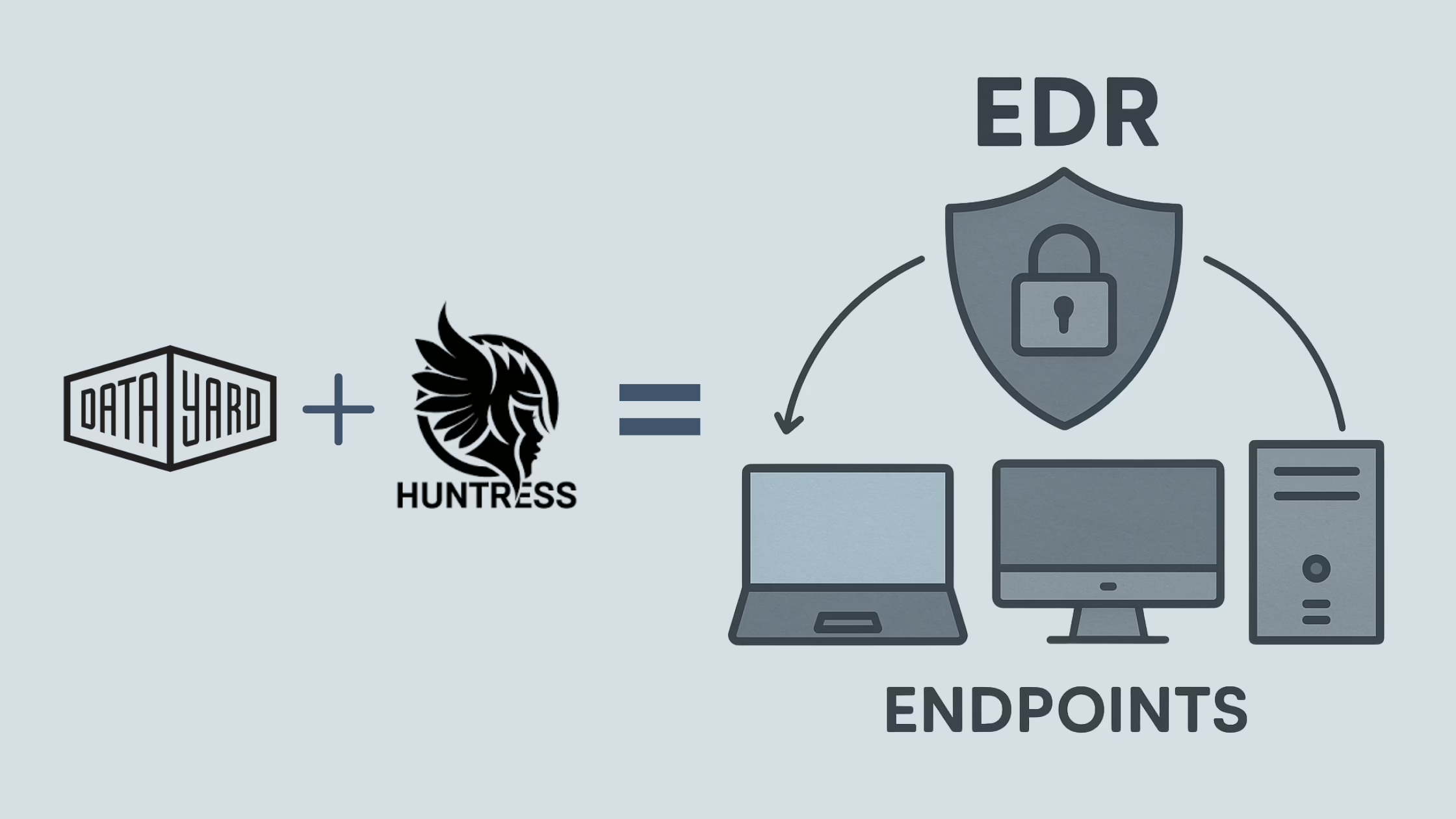
While many EDR tools stop at automated detection, our Huntress-powered EDR platform combines cutting-edge technology with a 24/7 Security Operations Center (SOC) that actively investigates suspicious activity.
The result? Instead of just telling you there’s a problem, you get rapid remediation with expert analysis 24/7/365.
What Huntress + DataYard Means for You
With Huntress in our corner, DataYard’s endpoint security solutions don’t just detect and block threats; they actively hunt them down and walk you through remediation. You gain faster response times, fewer false alarms, and the confidence that both machine intelligence and human expertise are monitoring your business 24/7.
If 2025 is the year you want to stop wondering whether your business could survive a cyber incident, the Huntress + DataYard Managed EDR solution is your answer.
As a DataYard client, this partnership gives you:
- Comprehensive protection on critical devices in your environment.
- Automated containment that isolates threats within seconds of detection.
- Human-led threat hunting to catch stealthy attacks that automation alone might miss.
- Forensic insight to understand how and why an incident occurred, so you can help reduce the likelihood of repeat incidents.
- Proactive policy tuning as threats evolve (because security is never “set it and forget it”).
This isn’t just about stopping ransomware. It’s about helping to prevent threats from gaining a foothold.
Best Practices for Maximizing Your Endpoint Security
Paired with an EDR solution like DataYard’s, these proven security processes can help give your business the strongest possible defense:
- Inventory every connected device: laptops, desktops, servers, and remote endpoints.
- Prioritize critical systems: focus protection on where the most sensitive data lives.
- Deploy managed EDR across all endpoints: centralized control equals consistent coverage.
- Establish an incident response plan: know exactly how to act when alerts trigger.
- Train your team: educated employees are your first line of defense.
- Continuously monitor and refine: threats change daily, and so should your defenses.
Free Complimentary Endpoint Security Consultation
Sit down with a DataYard cybersecurity specialist to evaluate your endpoint security strategy, so you can close gaps, reduce risk, and keep your business safe from evolving threats.
FAQ: Endpoint Security Solutions
How are endpoint and network security different?
Network security protects data in transit between systems, while endpoint security protects the devices where your users work (laptops, desktops, servers, mobile devices). Both are essential. If you’re unsure what you need, contact us with your security questions.
Is EDR affordable for small to mid-size businesses?
Yes, managed EDR scales to any size organization and avoids large upfront investments. Many businesses use EDR as a service to get enterprise-grade protection at a predictable monthly cost.
Will it slow my devices down?
Modern EDR solutions are designed to run efficiently in the background with minimal performance impact, even during active threat monitoring.
How fast does it detect new threats?
Most advanced EDR platforms detect suspicious activity within seconds and can automatically contain threats, likely before they spread, which is critical for fast-moving attacks like ransomware.
What if a breach still happens?
EDR’s forensic tools provide detailed insight into how the attack occurred, what systems were affected, and the best remediation steps, helping you to recover faster and prevent repeat incidents.
Does EDR replace antivirus software?
Not exactly. EDR is more advanced and includes continuous monitoring, automated response, and threat hunting, but many organizations run Endpoint Detection and Response (EDR) alongside modern antivirus for layered protection. Not sure what’s right for your cybersecurity stack? Let’s talk, we offer free consultations.
Disclaimer: This content is provided for informational purposes only and should not be considered legal, compliance, or security advice. Cybersecurity threats evolve rapidly, and no solution, including those mentioned, can guarantee complete prevention of every possible attack. For guidance tailored to your organization’s specific needs, please consult directly with our qualified cybersecurity professionals.