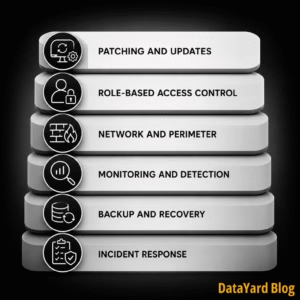
Layered Security: Why Patching Alone Is Not Enough
Patching matters. It also cannot be the whole strategy. Here is what layered security means in practice, and what three recent incidents reveal about the layers that catch what patching misses.
Cloud, infrastructure, cybersecurity, colocation, and more. Browse by topic or search for something specific.
Talk to our team →
Patching matters. It also cannot be the whole strategy. Here is what layered security means in practice, and what three recent incidents reveal about the layers that catch what patching misses.
On June 17, 2026, DataYard and Huntress hosted a live webinar on managed EDR and modern cybersecurity threats. This recap covers the key takeaways, including how managed EDR works, a real-world incident resolved in 52 minutes, a Huntress platform demo, and what deployment looks like for your organization. Plus, you will get exclusive access to the webinar video.
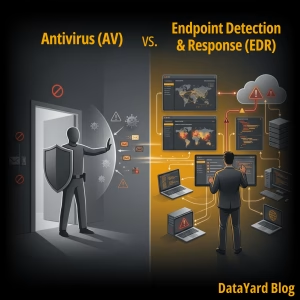
As Endpoint Detection & Response (EDR) becomes more widely discussed in cybersecurity, many businesses are asking whether EDR replaces traditional antivirus software, or whether they need both. Antivirus and EDR are built to solve different security problems. This guide breaks down how each works, where they overlap, and why a layered approach gives most organizations the strongest protection.

Anthropic’s newest AI model, Claude Mythos Preview, has been generating a lot of conversation in cybersecurity circles. Reports from Anthropic describe a model that may be capable of identifying previously unknown software vulnerabilities at scale, and some of our own clients have been asking what that means for their environments. Here’s what we know so far.

The Kettering Health cyberattack is a reminder that no organization is immune to disruption. For businesses that rely on constant system availability, even short outages can impact operations, revenue, and customer trust. This blog breaks down what events like this reveal about modern cybersecurity risks, and more importantly, what your organization can do to prepare. From layered security and monitoring to disaster recovery and hybrid-cloud resilience, learn how to reduce risk and recover quickly when it matters most.

A DDoS (Distributed Denial of Service) attack floods your infrastructure with traffic from thousands of sources — making your website or application unavailable to legitimate users. Mitigating a DDoS attack requires a layered defense strategy. No single tool can completely prevent these attacks, but combining CDN protection, scalable cloud infrastructure, hardened configurations, and continuous monitoring significantly reduces your risk. Learn 6 proven strategies organizations use to stop or mitigate DDoS attacks, and what to do if one hits.
Phishing remains one of the most dangerous cyber threats facing businesses today. Cybercriminals send deceptive emails and messages to trick employees into clicking malicious links, entering credentials on fake websites, or giving away personal information. Attack volume and sophistication have surged in recent years. This blog explains what a phishing email looks like, the biggest risks to your company, and how layered defenses — EDR, MFA, email security, and staff training — can dramatically reduce exposure and response time.

Cybersecurity can’t be limited to reacting to threats, especially when you don’t know where your real gaps are. Red and Purple Teaming flips the script; letting you simulate real-world attacks to uncover vulnerabilities, sharpen incident response, and improve your security posture before the stakes are high. In this blog, we break down what these exercises are, why they matter, and how to start using them effectively — including how to align them with your organization’s risk profile, budget, and level of maturity.

Keyloggers remain one of the most effective tools in both attacks and ethical security testing — silently capturing passwords, commands, and user input. This post breaks down how keyloggers operate and, more importantly, how to detect, test, and defend your systems against them in modern environments.

Manufacturing is now one of the most-targeted industries for cyberattacks, yet many teams don’t realize where they’re vulnerable. In this post, we’ll break down the top 3 cybersecurity threats facing manufacturers right now, including unpatched endpoints, cloud misconfigurations, and unsecured third-party access. Learn how to spot the gaps, improve your manufacturing cybersecurity posture, and protect your operations with clear, practical steps, plus a free RISE Foundations Assessment designed for teams just like yours.